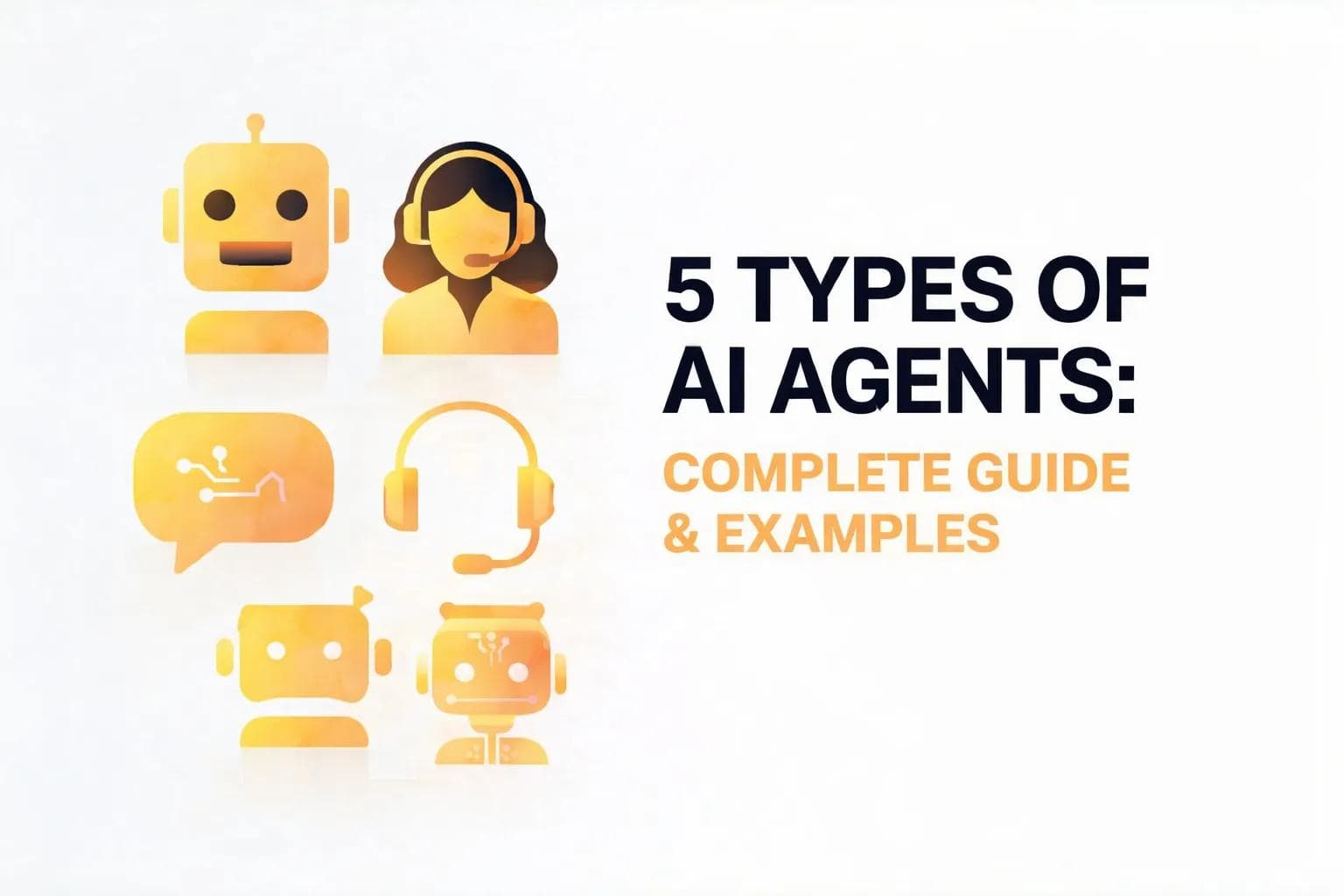
5 Types of AI Agents: Complete Guide & Examples (2026)

Ilias Ism
15 min read
AI agents are running your Netflix recommendations. They're navigating self-driving cars through city streets. They're answering customer support tickets while you sleep.
But not all AI agents work the same way. They're built on completely different levels of intelligence.
The types of AI agents range from simple rule-based systems to smart learning algorithms that improve with every interaction.
Understanding these differences matters if you want to choose the right AI solution for your business.
In this guide, we'll break down the five core types of agents in artificial intelligence. You'll see real-world examples of agents across industries, learn how each type of agent makes decisions and solves specific problems, and discover which one fits your needs.
Whether you're building a customer service chatbot or exploring autonomous systems, this classification will help you make smarter decisions about AI implementation.
Let's get into it.
What Makes an AI Agent? Core Characteristics
AI agents aren't just regular software programs. They have specific traits that set them apart.
Think about a basic calculator versus a spam filter. The calculator waits for your input and follows exact steps. The spam filter watches your inbox, learns what you consider spam, and blocks emails on its own. That's the difference.
They're autonomous, operating without constant human control. Your Netflix recommendation system doesn't ask permission before suggesting shows.
They're reactive. They sense changes and respond. A trading bot detects price drops and executes buy orders automatically.
They're proactive. They take action to reach goals. A chess bot doesn't wait for you to tell it the best move. It analyzes the board and suggests strategies.
These agents range from simple to complex. A spam filter follows pattern-matching rules. A self-driving car learns from millions of miles of data.
Understanding this range helps you pick the right agent for your problem.
The Five Types of AI Agents: Complete Classification
AI agents are classified based on how they make decisions and interact with their environment. Each type has different capabilities and works best for specific problems.
Here is a quick comparison of the five types of intelligent agents:
![[object Object]](/_next/image?url=https%3A%2F%2Fcdn.sanity.io%2Fimages%2Fi6kpkyc7%2Fprod-dataset%2F268e6ab25c2bb0e7b81cbcf7419a35554ee9920b-1376x768.jpg&w=3840&q=75)
Let's break down each one.
1. Simple Reflex Agents
![[object Object]](/_next/image?url=https%3A%2F%2Fcdn.sanity.io%2Fimages%2Fi6kpkyc7%2Fprod-dataset%2Fa3e0d9854337e82384de731344681b9f55c24c50-1376x768.jpg&w=3840&q=75)
Simple reflex agents are the most basic type of AI. They operate on a "condition-action" basis, following fixed rules to make immediate decisions. They have no memory of the past and no ability to plan for the future. They only care about what is happening at this exact moment.
Here's how they work: the agent sees its environment through sensors, matches that data against a set of if-then rules, and performs an action. If condition X happens, the agent triggers action Y. It doesn't consider context or history. It simply reacts.
Real-World Examples
Automatic door sensors detect motion and trigger the motor to open the door. They don't remember who walked through five minutes ago or predict if someone is about to arrive. They only react to the current signal.
Basic keyword chatbots look for specific words in a user's message. If you type "price," it triggers a preset response about pricing. If you ask the same question three times, you get the exact same answer three times because it has no memory of the previous interaction.
Traditional thermostats work on simple rules. If the temperature drops below 68°F, turn on the heater. They don't know it's winter or learn your preferred schedule. They just follow the rule.
These are common AI examples of simple automation you see every day.
Strengths and Limitations
Strengths:
- Speed: They respond instantly because there's no complex processing involved.
- Efficiency: They require very little computing power and are inexpensive to build.
- Reliability: They're 100% predictable in stable environments.
Limitations:
- No Context: They can't handle situations where they can't see the whole picture.
- Rigidity: If a situation isn't in their rulebook, they either do nothing or do the wrong thing.
- The Loop Problem: If the environment doesn't change after an action, they can get stuck repeating the same action forever, like a vacuum hitting a wall and never moving past it.
Best Use Cases
Simple reflex agents work best for static, highly predictable tasks. They're the backbone of industrial automation, basic IoT devices, and safety systems like circuit breakers that trip when they detect a power surge.
They're not suitable for tasks that require conversation, navigation, or any form of common sense.
2. Model-Based Reflex Agents
![[object Object]](/_next/image?url=https%3A%2F%2Fcdn.sanity.io%2Fimages%2Fi6kpkyc7%2Fprod-dataset%2F2d35fda60739e08d4ed6ecf13ec3c2f726062858-1376x768.png&w=3840&q=75)
Model-based reflex agents are a step up from simple reflex agents. Their defining feature is an internal state, a digital memory that allows them to track parts of the environment they cannot see at this exact moment.
Here's how they work: think of it like building a map in your head. These agents keep track of the world instead of just reacting to what they see right now. They remember how things change over time and how their own actions affect the world. This helps them work even when they cannot see everything at once. If they have a blind spot, they use their memory to fill in the gaps.
The key difference from simple reflex agents? Simple reflex agents only react to the current moment. Model-based agents remember the past and use that memory to make better decisions, even when they have blind spots.
Real-World Examples
Robotic vacuum cleaners don't just bounce off walls. They use sensors to build a floor plan of your home. They remember which rooms they've already finished and which ones still need cleaning. Even when the vacuum is under a bed and can't see the rest of the house, its internal model tells it exactly where the charging dock is.
Smart security systems track your normal activity patterns at home. They remember when you usually come and go, which doors get opened, and typical movement. When something unusual happens at 3 AM, they can tell it's different from your regular behavior and send an alert.
Industrial sorting robots in warehouses scan a package's barcode at the start of a conveyor belt. As the box moves down the line and out of sight, the robot arm at the end remembers which package is coming and which bin it belongs to. It uses its internal model of the belt's speed to time its movements perfectly.
Strengths and Limitations
Strengths:
- Handles Blind Spots: They work effectively even when information is missing or sensors are temporarily blocked because they remember what was there.
- Contextual Logic: They make decisions based on history and trends, not just a single data point.
- Efficiency: By modeling the world, they avoid repeating tasks like cleaning the same spot twice.
Limitations:
- Computational Load: Maintaining a real-time map or state of the world requires more memory and processing power than simple if-then rules.
- Model Accuracy: If the world changes (like moving furniture) and the agent doesn't update its internal model, it will make mistakes, like trying to drive through a space where a chair now sits.
Best Use Cases
Model-based agents are essential for navigation and logistics. They're the standard for any robot that needs to move through physical space or track items moving through a process, like delivery drones, warehouse sorters, or smart home systems.
They're also used in monitoring systems where tracking changes over time, like a system that monitors a patient's vitals in a hospital, is more important than reacting to a single data point.
3. Goal-Based Agents
![[object Object]](/_next/image?url=https%3A%2F%2Fcdn.sanity.io%2Fimages%2Fi6kpkyc7%2Fprod-dataset%2Fe6485661143f830c181bac43549b96aa11c5a3b2-1376x768.jpg&w=3840&q=75)
Goal-based agents go beyond just reacting or remembering. They plan their actions to achieve specific goals.
These intelligent agents ask: "What will happen if I do this? Will it help me reach my goal?"
Here's how they work: the agent has a clear objective. It uses its understanding of the world to think through different actions and their outcomes. Then it picks the action that's most likely to achieve its goal.
The key difference from model-based agents? Model-based agents react to their situation using memory. Goal-based agents look into the future and choose the best path forward. You can change the goal at any time without reprogramming the entire agent.
Real-World Examples
Self-driving cars have a goal: reach destination X safely. They don't just follow preset rules. They evaluate multiple routes, consider traffic conditions, and pick the path that gets them to the goal efficiently.
AI chess programs have a goal: win the game. They simulate thousands of possible moves and their consequences. Then they choose the move that's most likely to lead to victory.
Personal fitness apps have goals set by users: lose 10 pounds, run a 5K, build muscle. The app creates workout plans and adjusts them based on your progress toward the goal.
Strengths and Limitations
Strengths:
- Highly Flexible: You can change the goal at any time without rewriting the agent's code.
- Proactive Planning: They don't just react to what's happening. They look ahead to make sure their current actions lead to success.
- Problem Solving: They're excellent at finding a new path when an obstacle gets in the way of their original plan.
Limitations:
- High Computing Power: Searching through thousands of possible future moves requires a lot of processing speed and memory.
- Slower Response Times: Because the agent has to think and plan before it acts, it can be slower than a simple reflex agent.
- Complex Design: It's much harder to build an agent that can predict the future results of its actions accurately.
Best Use Cases
Use goal-based agents when you have clear objectives and multiple ways to achieve them. They work well for route planning, game AI, personal assistants, and project management tools.
They're perfect when flexibility matters more than speed. If your environment changes and you need the agent to adjust its approach, goal-based agents deliver.
4. Utility-Based Agents
![[object Object]](/_next/image?url=https%3A%2F%2Fcdn.sanity.io%2Fimages%2Fi6kpkyc7%2Fprod-dataset%2F63a98f9d2cff40b8a05f3064a6be9002fb5060e6-1376x768.jpg&w=3840&q=75)
Utility-based agents don't just aim for goals. They evaluate how good different outcomes are and pick the best one. They ask: "Which option gives me the most value?"
Here's how they work: the agent assigns a "happiness score" or utility value to different possible outcomes. Then it compares all options and chooses the action that maximizes this score.
The key difference from goal-based agents? Goal-based agents just need to reach the goal, any way works. Utility-based agents weigh trade-offs and optimize for the best possible result.
Real-World Examples
Flight booking systems balance multiple factors at once. They consider price, travel time, number of stops, and departure times. The system ranks options based on what matters most to you and suggests the flight with the highest overall value.
Dynamic pricing systems like Uber adjust prices in real-time. They weigh supply and demand, time of day, weather conditions, and competition. The goal isn't just to set any price but to find the optimal price that maximizes both driver availability and customer satisfaction.
Investment portfolio managers use utility-based agents to balance risk and return. They don't just aim for the highest profit. They calculate the best mix of investments that maximizes returns while keeping risk at an acceptable level based on your financial goals and risk tolerance.
Strengths and Limitations
Strengths:
- Handles Trade-offs: They excel at balancing competing priorities like speed versus cost.
- Optimal Results: They do not just find a solution that works. They find the best possible solution among many choices.
- Handles Uncertainty: They can make smart decisions even when they are not 100 percent sure what the outcome will be by calculating the most likely value.
Limitations:
- Complex Scoring: The agent is only as good as its scoring system. If the scoring is wrong, the agent makes poor choices.
- Heavy Computing Needs: Comparing many different paths and calculating scores for each one requires a lot of processing power.
- Difficult to Define: It can be very hard to turn human feelings, like "comfort" or "safety," into a mathematical utility score.
Best Use Cases
Use utility-based agents when you need to balance multiple factors or competing priorities. They work well for pricing systems, investment management, resource allocation, and financial trading.
They're ideal when "good enough" isn't good enough. You need the best outcome, not just any outcome that works.
5. Learning Agents
![[object Object]](/_next/image?url=https%3A%2F%2Fcdn.sanity.io%2Fimages%2Fi6kpkyc7%2Fprod-dataset%2F8dd2768a5cdb2e3d9f57de1472a859491690d26e-1376x768.jpg&w=3840&q=75)
Learning agents are the most advanced type. They improve their performance over time by learning from experience. Unlike other agents that follow fixed rules or models, learning agents adapt and get smarter with every interaction.
Here's how they work: the agent has four main parts. A learning element that improves the system based on feedback. A performance element that selects the actual actions. A critic that evaluates how well those actions worked. And a problem generator that suggests new strategies to try and explore.
The key difference? All previous agent types are limited to what they were programmed to do. Learning agents can discover new strategies and improve far beyond their initial programming.
Real-World Examples
![[object Object]](/_next/image?url=https%3A%2F%2Fcdn.sanity.io%2Fimages%2Fi6kpkyc7%2Fprod-dataset%2F2a840507b49410d21731add0f94eda006febcfcd-300x168.jpg&w=3840&q=75)
- Tesla's Autopilot is a true learning agent. When a human driver takes over or corrects the car, the system identifies the difference between its intended path and the human's action. This feedback is sent back to improve future versions of the software. Every Tesla on the road acts as a problem generator, encountering new scenarios that make the entire fleet smarter.
![[object Object]](/_next/image?url=https%3A%2F%2Fcdn.sanity.io%2Fimages%2Fi6kpkyc7%2Fprod-dataset%2Fa13221730b3274620e9de553dc004a7fb3e54615-1280x720.jpg&w=3840&q=75)
- ChatGPT and Claude learn from user feedback over time through Reinforcement Learning from Human Feedback (RLHF). When users give a thumbs down or provide corrections, they act as the critic. While the AI doesn't get smarter during your specific chat, this aggregate feedback is used to train the next, more capable version of the model.
![[object Object]](/_next/image?url=https%3A%2F%2Fcdn.sanity.io%2Fimages%2Fi6kpkyc7%2Fprod-dataset%2F2c61cf8a770c892d2c9d81750df34848be198e06-2282x1094.jpg&w=3840&q=75)
- Customer service chatbots that use feedback loops are learning agents. When they ask "Was this helpful?" and adjust their future responses based on those scores, they're learning which information is most valuable. You can build these learning agents yourself using platforms like Chatbase that automate the training and feedback loops..
Strengths and Limitations
Strengths:
- Highly Flexible: They are the most powerful type of agent because they can adapt to almost any new situation.
- Handles the Unexpected: They can deal with new problems that their original programmers did not predict or plan for.
- Continuous Self-Improvement: They get better at their jobs over time without a human needing to rewrite their code.
- Discovers New Strategies: They often find clever ways to solve problems that even their creators did not think of.
Limitations:
- Data Hungry: These agents need a massive amount of information and examples to learn how to work correctly.
- High Resource Costs: It takes a long time and a lot of expensive computer power to train these agents effectively.
- Risk of Bad Lessons: If the feedback or data they receive is biased or incorrect, the agent will learn the wrong behaviors.
- Requires Constant Monitoring: Humans must watch these agents closely to make sure they do not develop harmful or unfair patterns.
Best Use Cases
Use learning agents when you need continuous improvement and adaptation. They work well for autonomous vehicles, AI assistants, recommendation systems, and any application where conditions change frequently.
They're essential when the problem is too complex to program all rules upfront. Let the agent learn the best approach through experience rather than trying to predict every scenario.
Conclusion
Understanding the types of AI agents is the first step to making smarter AI decisions for your business. Each agent type solves different problems, and knowing which one fits your situation saves time and money.
The Five Agent Types:
- Simple reflex agents follow fixed rules for predictable tasks.
- Model-based agents use memory to work with incomplete information.
- Goal-based agents plan paths to reach objectives.
- Utility-based agents balance competing priorities.
- Learning agents improve through experience.
How to Choose the Right One
![[object Object]](/_next/image?url=https%3A%2F%2Fcdn.sanity.io%2Fimages%2Fi6kpkyc7%2Fprod-dataset%2F6b94d34dd64ed5c7e7d05043e8ff21dd636319ab-1376x768.png&w=3840&q=75)
Start simple. Don't build a learning agent when a reflex agent solves your problem. Match complexity to your actual needs, not what sounds impressive.
Look at your environment. Stable situations need simple solutions. Dynamic, changing conditions need agents that adapt.
Think long-term. Learning agents cost more upfront but improve without reprogramming. Simple agents are cheaper but stay the same forever.
The Bottom Line
AI agents aren't the future anymore. They're transforming businesses right now. Customer service, pricing, recommendations, automation - these technologies deliver real results today.
The question isn't if you should use AI agents. It's which type fits your problem and how fast you can implement it.
Ready to start? Build your AI customer service agent with Chatbase and automate support without losing the personal touch.
Share this article: